.png)


By using our website, you agree to the use of cookies as described in our Cookie Policy
We Are Happy to Service All Carlynda Jewelers Clients
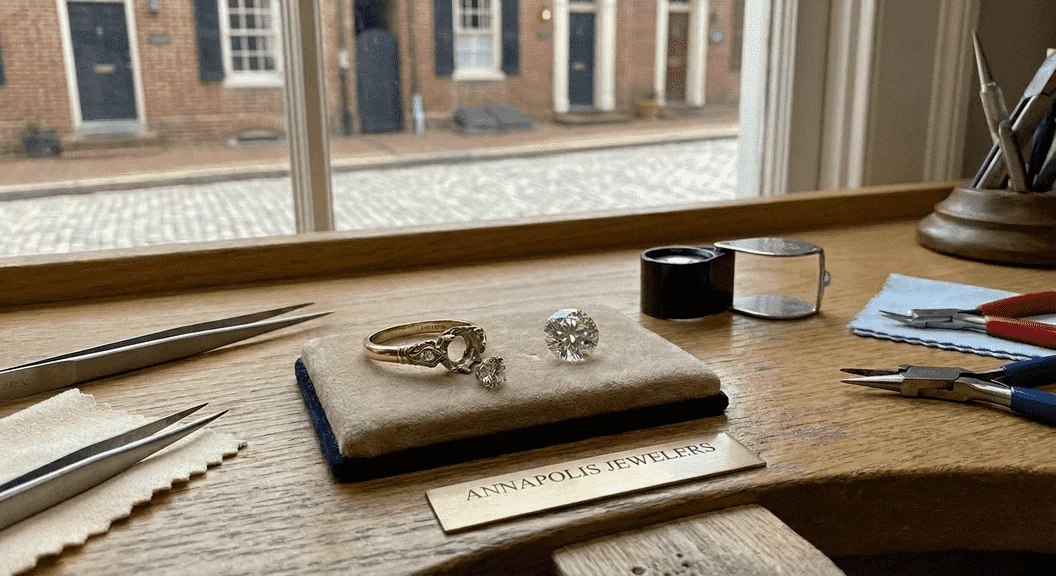
What Goes Into Matching a New Diamond to Your Existing Ring
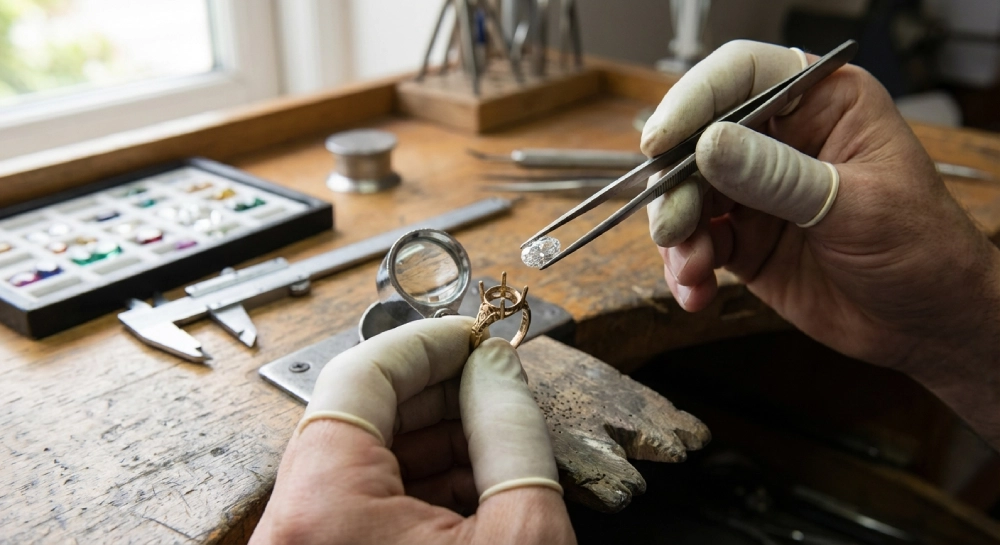
Most people think swapping a diamond is simple. Pick a stone, drop it in, done. But jewelers know better — and if you don't, you're risking a mismatch that shows. Diamonds may all sparkle, but they don't all fit the same way. Especially when you're working with an existing setting that wasn't built for just any stone.
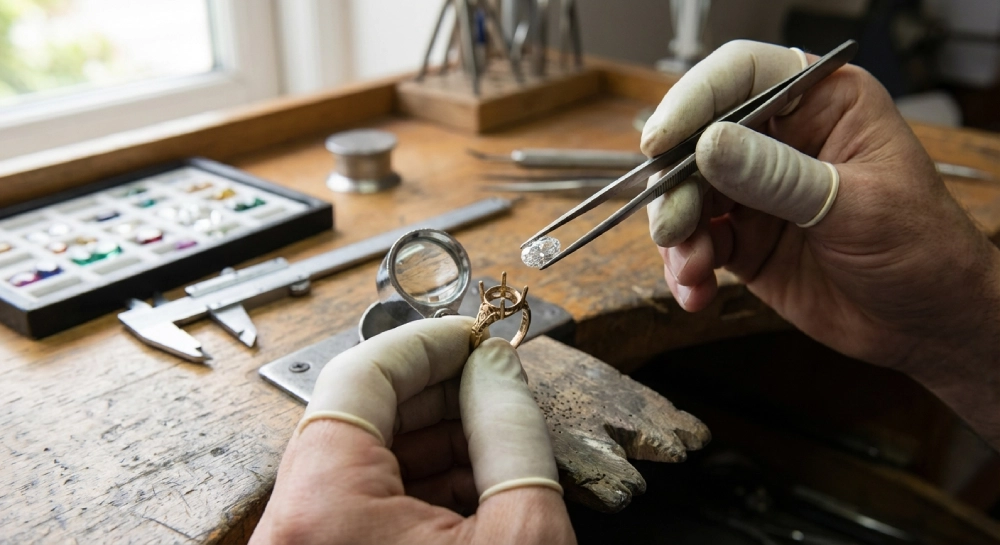
So here's what matters. If you're upgrading or replacing a center stone, that's exciting. Just don't assume any diamond will work. Every stone needs to match the setting's structure. Every choice affects how the ring looks under light. And every decision should be grounded in how the diamond interacts with the metal — not just how it looks in a display case.
The Setting Tells You What It Can Handle
Before we even talk about diamonds, we need to look at what you're working with. The ring itself has limits. Prong style, basket depth, gallery height — all of that dictates what kind of stone fits without forcing modifications. If the setting was built for a round brilliant and you want to go cushion cut, the jeweler may need to rebuild the head entirely.
Metal type plays a role too. White gold shows off colorless stones differently than yellow gold does. Platinum holds a stone tighter than softer metals. And if the ring's been worn for years, the prongs might be thin or bent. We check all of that before we even measure for a new diamond. Because no stone is worth setting if the foundation can't support it.
Shape Dictates More Than Style
You can't just pick a shape you like and call it a day. The diamond's outline has to work with the setting's architecture. Round stones are forgiving — they fit most heads without drama. But fancy shapes? Those get picky fast.
Here's where shape matters most:
- Oval and marquise diamonds need prongs positioned to protect the points without blocking light
- Princess cuts require V-tip prongs or you're asking for chipped corners
- Emerald and Asscher cuts show more of the pavilion, so depth and symmetry become critical
- Pear shapes need to sit with the point aligned perfectly or the whole ring looks crooked
- Cushion cuts vary wildly in length-to-width ratio, so one cushion won't necessarily fit where another did
Size Isn't Just About Carat Weight
A two-carat diamond doesn't always measure the same as another two-carat stone. Cut proportions change the face-up size. A deep stone might weigh more but look smaller. A shallow one spreads wider but sacrifices brilliance.
We measure the setting's dimensions first — length, width, depth — then find a diamond that fits those specs without gaps or overhang. If the new stone is even half a millimeter off, the jeweler has to adjust prongs, resize the head, or add spacers. And if you're going significantly larger, the band itself might need reinforcement. Because a bigger diamond means more weight pulling on the shank, especially if you wear the ring daily.
The Four Cs Have to Play Together
Cut quality determines how much light comes back at you. Color affects whether the stone looks icy or warm against the metal. Clarity shows up more in some shapes than others. And carat weight is just mass — it doesn't mean much if the other three are off.
If your ring has side stones, matching becomes even trickier. The center diamond's color should sit within one or two grades of the accents, or the difference will show. Same with clarity — if the side stones are eye-clean and the center has visible inclusions, that's a problem. We've seen people try to save money by dropping color or clarity on the center stone, thinking no one will notice. They notice.
What the Jeweler Checks Before Setting
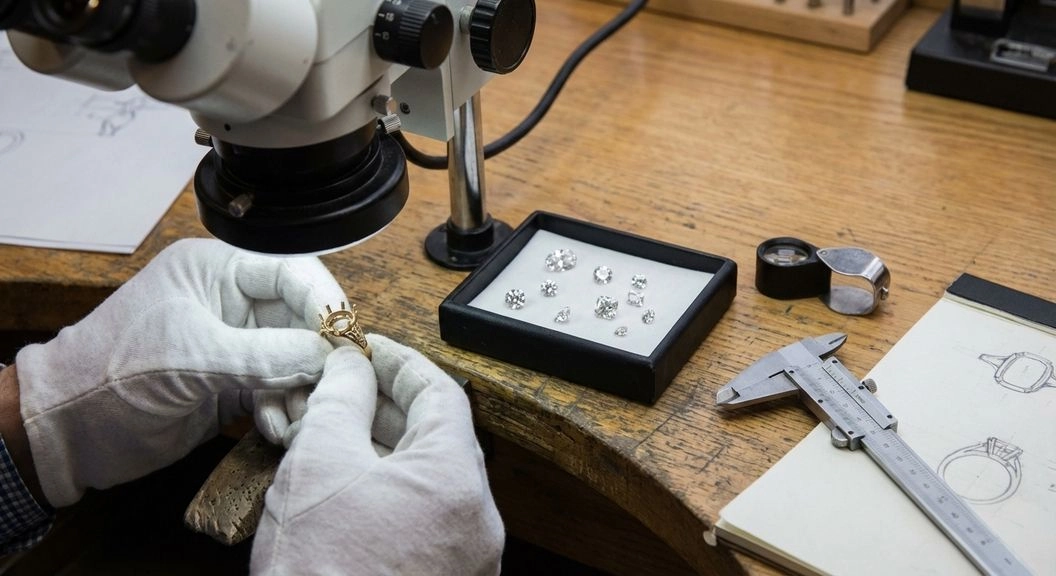
Once the diamond's selected, the real work starts. The jeweler inspects the setting under magnification, checking for weak points, worn prongs, or hidden damage. If the ring's been resized before, there might be solder joints that need reinforcing. If it's an antique piece, the metalwork could be brittle.
Here's what gets evaluated before the stone goes in:
- Prong thickness and integrity — bent or thin prongs get rebuilt
- Head alignment — if the setting's crooked, the diamond will sit crooked too
- Gallery clearance — the stone needs room to breathe or it traps dirt and looks dull
- Shank condition — cracks, dents, or wear spots get addressed first
- Accent stone security — loose side stones get tightened before the center goes in
Certification Isn't Negotiable
We don't set uncertified diamonds. Period. A grading report from GIA, AGS, or another reputable lab gives you proof of what you're buying. It also protects you if something happens down the line — insurance, resale, or appraisal all hinge on that documentation.
If someone offers you a "deal" on a diamond without a cert, walk away. You have no idea what you're getting. And if the jeweler tries to talk you out of certification to save money, find a different jeweler. Because the cost of a report is nothing compared to the cost of a bad stone you can't verify.
Common Mistakes We See All the Time
Plenty of people try to DIY this process or cut corners to save a few bucks. It rarely ends well. The most common screwups? Buying a diamond online without seeing it in person, assuming any stone will fit, and skipping the jeweler's inspection because "the ring looks fine."
Here's where people go wrong:
- Ordering a diamond based on measurements alone, then finding out it doesn't match the setting's depth
- Ignoring fluorescence, which can make a diamond look hazy under certain lighting
- Choosing a stone with inclusions near the girdle, where prongs will put pressure and risk chipping
- Skipping the polish and symmetry grades, which directly affect how the diamond performs
- Trying to reuse old prongs that are too worn to hold a new stone securely
When You Need More Than a Simple Swap
Sometimes matching a new diamond means rebuilding part of the ring. If you're going from a small stone to a large one, the head might need to be replaced entirely. If you're changing shapes, the prong configuration has to change too. And if the ring's an heirloom with sentimental value, you want a jeweler who understands how to preserve the original design while making it functional.
This is where experience matters. A skilled jeweler can modify a setting without losing its character. They know how to reinforce weak points, match patina on older metals, and keep engraving or milgrain intact. If you hand your ring to someone who just wants to get the job done fast, you'll get a Frankenstein result that doesn't look or feel right.
Why Shortcuts Cost More in the Long Run
Trying to save money by skipping steps or using a cheaper jeweler usually backfires. We've seen rings come in with diamonds set crooked, prongs that don't hold, and metalwork that's been damaged by careless bench work. Fixing those mistakes costs more than doing it right the first time.
The same goes for buying a diamond without proper vetting. If you grab a stone based on price alone and it turns out to be poorly cut or misgraded, you're stuck with it. Or you're paying to replace it again. Either way, you lose.
Getting It Right From the Start
Matching a new diamond to your existing ring isn't about finding the biggest stone or the cheapest deal. It's about understanding what your setting can handle, choosing a diamond that fits both physically and aesthetically, and working with a jeweler who knows how to execute the job without compromise.
We've guided thousands of clients through this process — from simple replacements to full upgrades that transform a ring entirely. The ones who take the time to do it right walk away with something that looks seamless, wears securely, and holds its value. Those considering custom design services can explore options for resetting a diamond ring or even designing a custom ring from scratch. Understanding what metals work best for engagement rings and learning about the best diamond cut can make all the difference. The ones who rush or cut corners? They're back in six months asking us to fix what someone else botched. Your ring deserves better than that.
Let’s Make Your Ring Shine Again
Your ring is more than just jewelry—it’s a story you wear every day. When it’s time to match a new diamond, let’s make sure it’s done right from the start. We’re here to answer your questions, walk you through your options, and deliver results you’ll love for years to come. Give us a call at 410-266-9559 or get a quote and let’s bring your vision to life together.
‹ Back
Recent Posts
-
Can You Give a Family Heirloom New Life With Custom Jewelry in Annapolis?
September 10, 2026
-
How Do You Choose the Right Wedding Band in Annapolis?
August 4, 2026
-
-
-